|
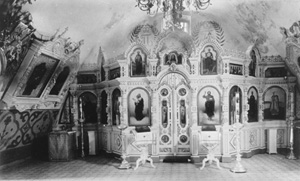 A monument above the common graves of the Russian warriors killed
in the Battle of Poltava was dedicated on June 27, 1895. This monument, which
consisted of a heavy granite cross, soon started to sink into the burial mound.
A monument above the common graves of the Russian warriors killed
in the Battle of Poltava was dedicated on June 27, 1895. This monument, which
consisted of a heavy granite cross, soon started to sink into the burial mound.
In 1906 the decision was made to open the burial mound,
reinforce the foundation of the memorial, and build an inner chapel with a
spherical vault, based on a design by the architect Nosov.
While construction was under way a few photographs were taken,
which were later discovered in the War Archives in Stockholm. These photos
show that the grave chapel had a small
window and a north-facing entrance. It contained a few
marble plaques listing the Russian regiments that participated in the Battle of Poltava and showing
their colours and laurel wreaths. The inner walls and the vault
were painted by the artist Sokol.
The chapel, named St. Peter and Paul Chapel in honour
of the apostles, was consecrated to God on September 3, 1907. In the 1930s a pig-breeding
research institute was established near the common graves,
and the grave chapel was turned into a storage facility for fuel and chemicals
by the institute’s director. This resulted in the destruction of the ventilation
system and all of the wall paintings. The walls themselves began to disintegrate because
of the dampness and chemical fumes.
Although the chapel was
repaired several times after WWII, its unique interior has been lost forever.
For a period of time the chapel was turned into a simple, somber memorial
hall, with a grave stone its only decoration. Today the chapel is closed to visitors.
|
 History
 Poltava
 Main page
 ...back